
The Hidden Cost of Your Fragmented Marketing Stack
If you run a small business or manage a growing brand, your browser bookmarks probably look like a digital graveyard of single-purpose software. You use one tool to schedule tweets, another to check keyword rankings, a third to optimize your website code, and yet another to respond to Google reviews. Before you know it, you are paying over five hundred dollars a month just to keep the lights on across ten different dashboards.
This fragmentation creates a massive drain on your most precious resource: time. Constantly context-switching between tools destroys your focus, while managing separate subscriptions eats into your profit margins. Worst of all, your data stays trapped in silos. Your social media metrics do not talk to your SEO analytics, leaving you blind to the big picture. Adopting an all in one marketing platform changes everything by bringing your entire growth engine under one roof.
What to Look for in a Consolidated Marketing Solution
Not all consolidated marketing tools are created equal. Many legacy platforms simply bundle clunky interfaces together and charge enterprise prices. To truly replace your stack, you need a solution built for modern efficiency that relies on smart automation rather than manual busywork.
When evaluating platforms, look for core capabilities that cover your daily operational needs. Can it publish content to your social feeds automatically? Does it actively audit and fix technical SEO issues on your website? Can it write optimized blog content without needing a dedicated copywriter? By checking these boxes, you ensure your new software actually replaces your old tools instead of just adding to the pile.
Core Features Your Unified Platform Needs
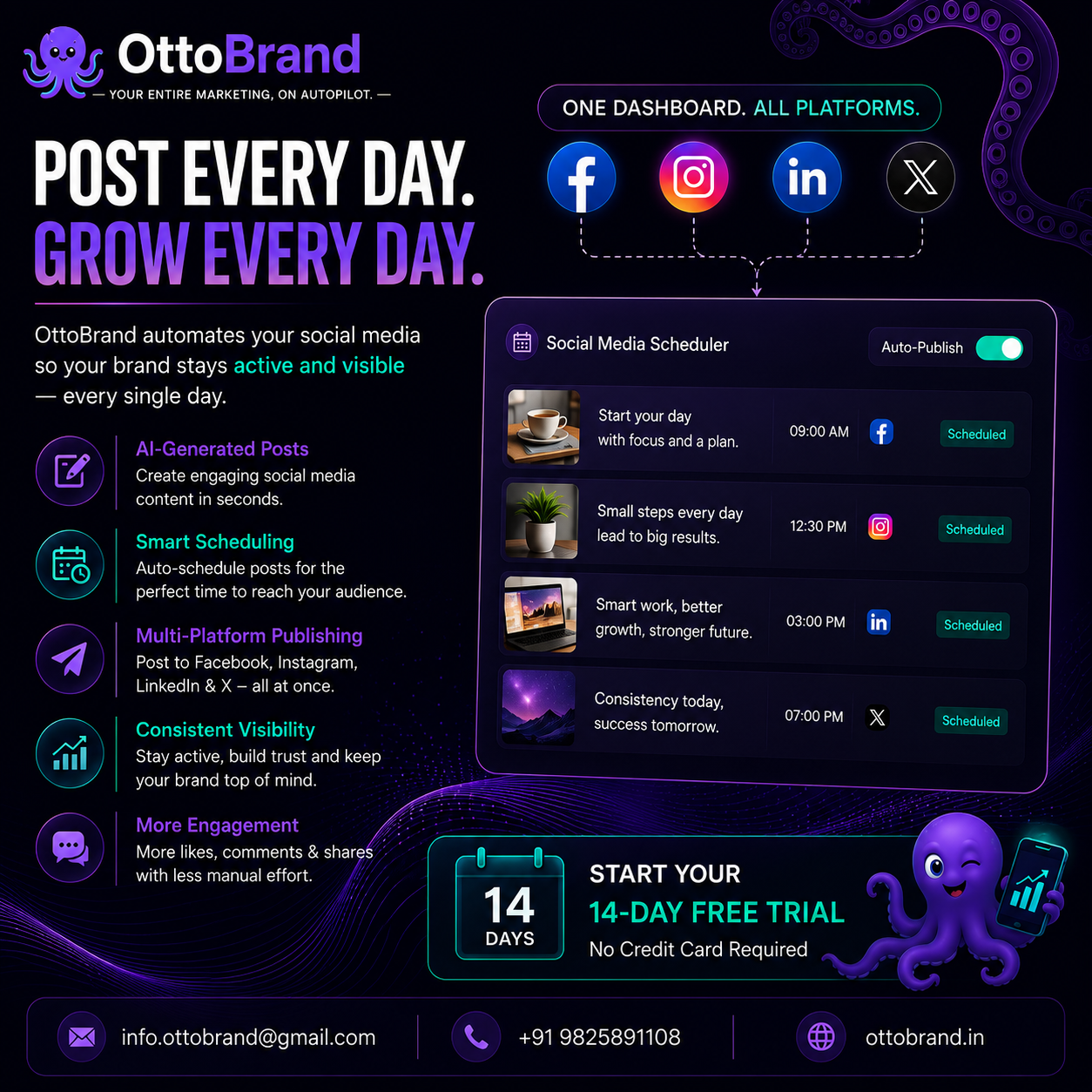
- Automated Social Media Publishing: Queue up weeks of content across multiple channels in minutes.
- AI-Driven SEO Blog Writing: Generate search-optimized articles that match your brand voice.
- On-Site SEO Fixes: Automatically detect and resolve broken links, missing meta tags, and slow-loading pages.
- Google Business Profile Management: Respond to reviews, update hours, and post local updates from a single dashboard.
How ottoBrand Replaces Your Fragmented Tools on Autopilot
Switching to a unified platform sounds great in theory, but execution is everything. This is where ottoBrand stands apart by leveraging advanced artificial intelligence to run your marketing operations on complete autopilot. Instead of logging into ten different tabs every morning, ottoBrand handles the heavy lifting behind the scenes.
For instance, managing your blog and social media channels usually requires a dedicated content calendar and hours of drafting. With ottoBrand, the system auto-writes SEO blogs tailored to your target audience and immediately repurposes those insights into engaging social media posts. It continuously scans your website for technical SEO flaws and applies fixes, ensuring your search rankings climb without requiring a background in web development.
Streamlining Local SEO and Google Business Profile Management
If you run a local business, your Google Business Profile is arguably your most important digital storefront. Yet, keeping your hours updated, posting weekly offers, and responding to customer reviews often falls by the wayside when you are busy running your actual business. Fragmented tools make this process cumbersome, requiring separate logins just to say thank you to a five-star review.
A true all-in-one marketing platform integrates local reputation management directly with your content strategy. ottoBrand manages your Google Business Profile automatically, helping you capture local search traffic, collect glowing reviews, and maintain accurate business listings across the web. When local customers search for your services, your business appears polished, responsive, and authoritative.
Calculating Your ROI: Time and Money Saved
Let us look at the hard numbers. Consider a typical modern marketing stack:
- Social Media Scheduler: $50/month
- AI Writing Assistant: $40/month
- SEO Audit Tool: $99/month
- Local Listing Manager: $60/month
- Website Optimization Plugin: $30/month
That totals nearly $280 every month for tools that do not communicate with each other. More importantly, factor in the hidden labor cost. Spending just one hour a day jumping between these platforms adds up to over twenty hours a month of lost productivity. Consolidating into a single, automated platform slashes your software overhead by up to 80% while giving your team their time back to focus on high-level strategy and customer service.
The Step-by-Step Transition Plan
Transitioning away from a messy tech stack does not have to be stressful. Follow this simple framework to make the switch smoothly over the course of a single weekend:
- Audit Your Current Tools: List every marketing subscription you currently pay for, along with its renewal date and primary use case.
- Cancel Redundant Subscriptions: Identify single-feature tools whose core functions are fully covered by your new all in one marketing platform.
- Import Your Assets: Upload your brand guidelines, target keywords, and social media handles into your new unified dashboard.
- Activate Automation: Turn on automated blogging, social scheduling, and SEO monitoring features to let the system take over the daily grind.
Consolidating your marketing tools is not just about saving money on software subscriptions; it is about reclaiming the mental clarity needed to grow your business.
Conclusion
The era of juggling ten different marketing subscriptions is officially over. Fragmented software slows you down, drains your budget, and leaves critical tasks falling through the cracks. By moving to an all in one marketing platform, you eliminate operational friction and put your growth on autopilot. Whether you want to automate your SEO, streamline social media posting, or manage local reviews effortlessly, embracing consolidation is the smartest move you can make for your business this year.